
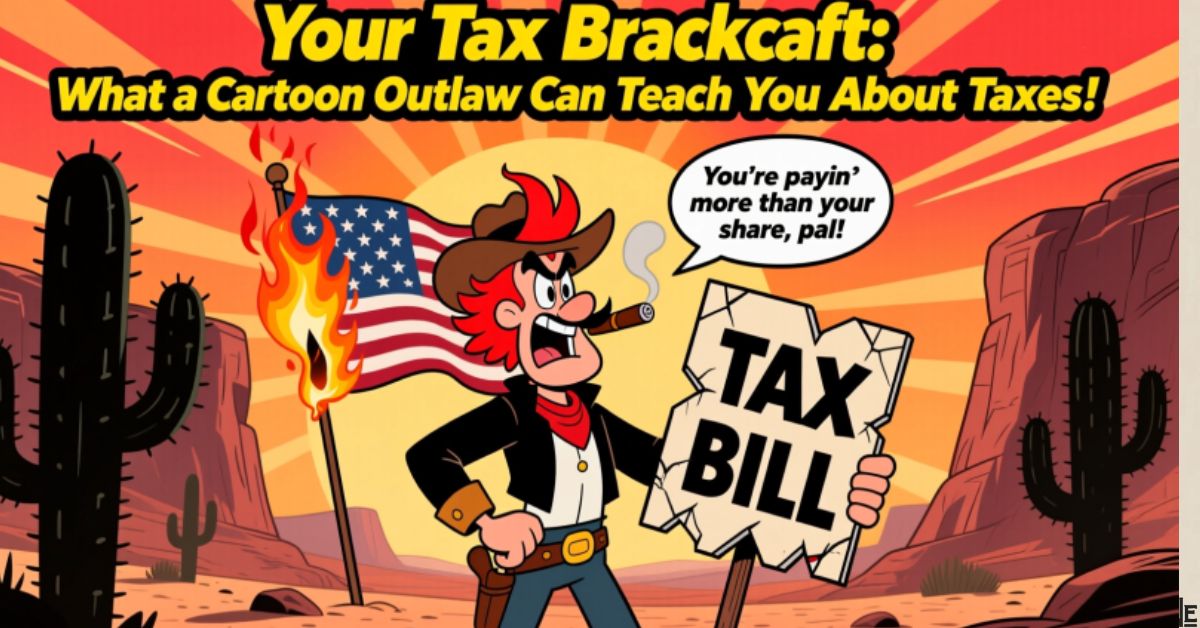

You know what’s wild? We’ve all seen Yosemite Sam—red mustache, twin revolvers, temper hotter than a jalapeño in July—yelling about gold mines, train robberies, or how Bugs Bunny “done double-crossed” him. But what if I told you that this 1940s cartoon bandit might just hold a mirror to your tax situation?
Stick with me. This isn’t some fever dream after too much coffee. There’s a real, surprisingly useful lesson here about how the U.S. tax system works—and why you might be paying more (or less) than you think.
Wait—Is Yosemite Sam Even in a Tax Bracket?
Great question. Of course, Sam never filed a Form 1040. But if he had—say, after striking it rich in a Nevada silver claim or running a saloon in Dodge City—he’d have landed in a tax bracket just like the rest of us.
And that’s where things get interesting.
Because here’s the thing most folks get wrong: your tax bracket isn’t your tax rate. Not really. And Yosemite Sam—blustering, all-or-nothing, “I’ll blow ya to smithereens!” Sam—is the perfect metaphor for why.
Think about it. Sam doesn’t just sort of get mad. He goes full scorched-earth. But the IRS? It doesn’t work that way. It’s not an all-or-nothing showdown at high noon. It’s more like… a layered cake. Or maybe a saloon where you pay more per drink the deeper you go—but only for the drinks above a certain level.
So How Do Tax Brackets Actually Work?
Let’s cut through the fog. The U.S. uses a progressive tax system. That means as your income rises, the additional dollars you earn get taxed at higher rates—but only those extra dollars.
For 2025 (yep, we’re already there—happy Monday, by the way), the federal income tax brackets for single filers look like this:
- 10% on income up to $11,600
- 12% on income from $11,601 to $47,150
- 22% from $47,151 to $100,525
- 24% from $100,526 to $191,950
- 32% from $191,951 to $243,725
- 35% from $243,726 to $609,350
- 37% on income over $609,350
Now, if you make $100,000 a year, you’re not paying 24% on your whole salary. Only the slice above $100,525 would hit that rate—and since you’re just under it, you’d max out at 22% for the top chunk.
This is where Sam’s “all or nothing” attitude fails him—and where smart taxpayers win.
Why People Feel Like They’re in a Higher Bracket Than They Are
Ever heard someone say, “I got a raise, but now I’m in a higher tax bracket, so I’m actually taking home less”? That’s a myth—but a stubborn one.
Here’s the truth: You can never lose money by earning more under the current U.S. system. The higher rate only applies to the income above the threshold. So if you cross from the 22% bracket into the 24% bracket, only the dollars beyond $100,525 get taxed at 24%. The rest? Still taxed at 10%, 12%, or 22%.
It’s like ordering tacos. The first three cost $3 each. The fourth? $4. You wouldn’t say, “Forget it—I’ll stick with three, or I’ll go broke!” No, you enjoy the fourth taco and pay the extra buck just for that one.
Yet somehow, when it comes to taxes, logic flies out the window faster than Sam chasing Bugs in a runaway mine cart.
ALSO READ THIS POST:The Honda NX400 2026: What It’ll Cost You—and Why It Might Be Worth Every Penny
The Real Tax Trap Isn’t the Bracket—It’s the Phaseouts
Here’s where things get sneaky. While your marginal tax rate (that top bracket slice) matters, what really bites people are stealth taxes: phaseouts of credits and deductions.
Take the Earned Income Tax Credit (EITC). Great for low-to-moderate earners—but it starts shrinking once you hit certain income levels. Same with the Child Tax Credit. Or eligibility for Roth IRA contributions. Or even student loan interest deductions.
These aren’t listed in the bracket tables, but they act like hidden tax hikes. You might not jump into the 24% bracket, but if your $95,000 salary knocks you out of a $2,000 credit? That’s effectively a 20%+ tax on that last $5,000—even if your official bracket says 22%.
So while Yosemite Sam is busy yelling about “government thieves,” the real culprit might be a quiet IRS form quietly trimming your benefits.
“But I’m Not Rich!”—And That’s Exactly the Point
Let’s be real: most Americans aren’t making $600K a year. In fact, the median household income in 2024 was around $80,610 (U.S. Census data). That puts a typical family of two earners right around the 22% bracket—maybe flirting with 24% if they’re in a high-cost area.
Yet thanks to inflation and wage growth (or lack thereof), more people are bumping into higher brackets without feeling richer. That’s called bracket creep—and it’s been happening for decades.
The tax code is adjusted for inflation (thanks to the Tax Cuts and Jobs Act of 2017 switching to “chained CPI”), but it’s not perfect. And state taxes? That’s another layer—California, New York, and Minnesota can tack on 9% or more on top of federal.
So yeah, you might not be Yosemite Sam with a sack of gold nuggets, but you could still feel squeezed.
What Should You Actually Do About It?
First, stop fearing the bracket. Seriously. If you get a raise, take it. Always.
Second, know your effective tax rate—that’s your total tax bill divided by your total income. For someone making $100K, it’s probably around 13–15%, not 22%. TurboTax, H&R Block, or even the IRS’s own Tax Withholding Estimator can help you see the real picture.
Third, hunt for above-the-line deductions. These reduce your adjusted gross income (AGI)—which affects everything from credits to Medicare premiums. Think:
- Contributions to a traditional IRA or 401(k)
- HSA contributions (if you have a high-deductible health plan)
- Student loan interest (up to $2,500)
- Educator expenses (if you’re a teacher)
Every dollar you knock off your AGI is a dollar that doesn’t push you closer to a phaseout cliff.
The Emotional Side of Taxes (Yes, It Exists)
Let’s not pretend taxes are just math. They’re emotional. They feel personal. When you see a big chunk vanish from your paycheck, it’s easy to feel like Yosemite Sam—cornered, furious, ready to draw.
But here’s a gentle truth: the system isn’t out to get you. It’s clunky, outdated in places, and full of loopholes for the ultra-wealthy—but for most working folks, it’s actually pretty fair if you understand how it bends.
And that’s the key: understanding beats outrage every time.
You don’t need to memorize the tax code. But knowing that brackets are marginal—not total—changes everything. It turns panic into planning. It swaps cartoonish rage for calm strategy.
A Quick Note on State Taxes (Because Sam Didn’t Stay in One Place)
Yosemite Sam roamed from deserts to snow-capped peaks—just like your tax burden changes if you move from Texas (no state income tax) to Oregon (up to 9.9%).
If you’re considering a move—or even remote work across state lines—don’t ignore this. Some states tax you based on where your employer is, not where you sleep. Others have reciprocity agreements. It’s messy.
Tools like SmartAsset’s State Tax Calculator or NerdWallet’s tax guides can give you a rough idea. But if you’re earning serious money or splitting time between states, talk to a CPA. Seriously. It’s worth the $200.
Final Thought: Be Smarter Than the Cartoon
Yosemite Sam never learns. He charges in, guns blazing, and always loses to a rabbit in a carrot patch.
But you? You’ve got something Sam never had: information. And a little strategy.
So next time you hear “tax bracket,” don’t picture a trap. Picture a staircase. You climb it one step at a time, and only pay more for the steps above you. The view gets better the higher you go—and the government only takes a slice, not the whole pie.
And if you’re still stressed? Remember: even Bugs Bunny files his taxes. (Okay, maybe not—but wouldn’t that be a great cartoon?)
Bottom line: Your tax bracket isn’t your enemy. Ignorance is. So arm yourself—not with revolvers, but with knowledge. And maybe, just maybe, you’ll outsmart the system without ever saying “varmint” once.