
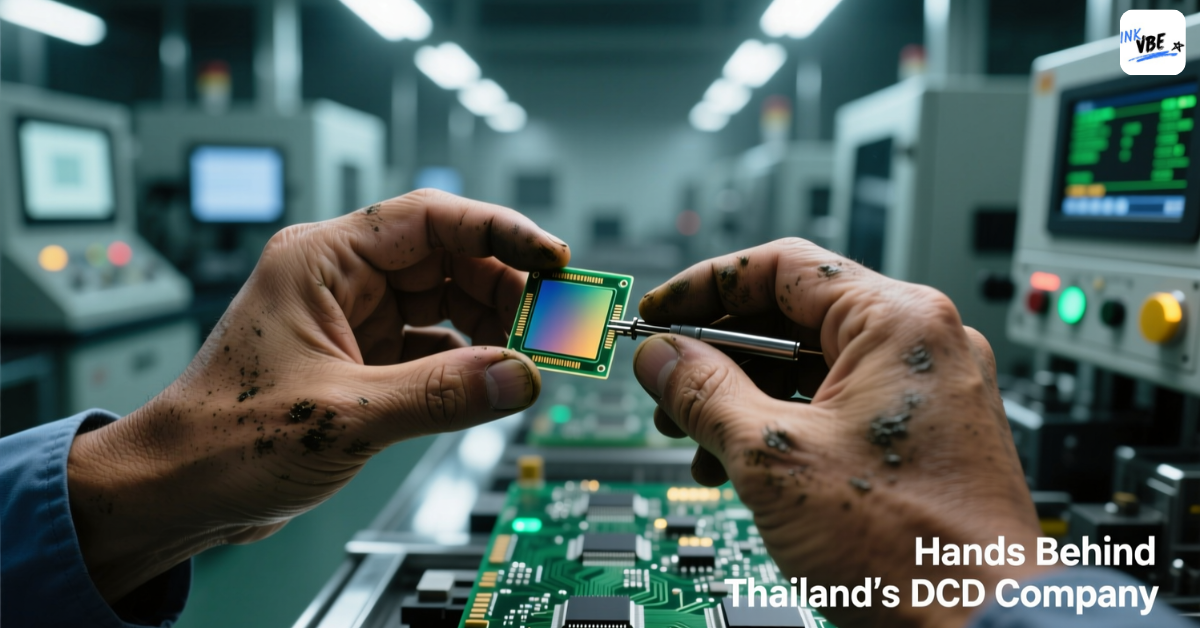

You’ve probably never heard of DMD Company unless you’ve spent time poking around Thailand’s industrial underbelly—or maybe you stumbled on a shipping manifest with their logo. But if you’ve ever worn a pair of sneakers made in Southeast Asia, driven a car with Thai-sourced parts, or even scrolled past a viral TikTok filmed in Bangkok, there’s a decent chance DMD’s auxiliaries had a hand in it.
Wait—what even are “auxiliaries” in this context? Good question. They’re not sidekicks in capes or backup singers. In the world of global manufacturing and logistics—especially in a place like Thailand, where supply chains twist like jungle vines—“auxiliaries” refer to the supporting network: subcontractors, logistics partners, maintenance crews, quality inspectors, even the folks who keep the factory Wi-Fi running. They’re the quiet infrastructure that lets a company like DMD hum along without missing a beat.
So who is DMD Company, anyway?
Not the DMD You’re Thinking Of
First things first: no, this isn’t about Duchenne Muscular Dystrophy or digital micromirror devices. DMD Company Limited is a Thai industrial player with fingers in everything from precision machining to automotive components and even renewable energy systems. Headquartered in Rayong—one of Thailand’s heavy-hitting industrial zones near the Gulf of Thailand—the company has been around since the early 2000s, quietly growing into a linchpin for multinational clients, especially from Japan, Europe, and yes, the U.S.
But here’s the kicker: DMD doesn’t do it alone. In fact, it can’t. Modern manufacturing is too complex, too fast-moving, too globally entangled for any single entity to handle every bolt, byte, and barcode. That’s where the auxiliaries come in.
The Ecosystem, Not the Engine
Think of DMD as the conductor of an orchestra. The music—the finished product—might carry their name, but without the violinists, percussionists, and even the guy tuning the piano backstage, the performance falls flat.
In practical terms, DMD’s auxiliaries include:
- Tier-2 and Tier-3 suppliers who provide raw materials like specialty alloys or custom-molded plastics
- Local logistics firms that shuttle parts between Rayong, Laem Chabang Port, and assembly plants across the Eastern Economic Corridor (EEC)
- Technical service providers handling everything from CNC machine calibration to ISO compliance audits
- Labor contractors who manage skilled technicians and assembly-line workers, especially during peak production cycles
- Software integrators keeping DMD’s ERP and MES systems synced with clients’ platforms—think SAP or Oracle, but tailored for Thai workflows
You might not see these names on the final invoice, but remove them, and the whole operation grinds to a halt. Literally.
Why Should Americans Care?
Fair point. If you’re sipping coffee in Des Moines or stuck in traffic outside Atlanta, why worry about a web of Thai subcontractors?
Because that web is stitched into your daily life.
Take the automotive sector. Thailand is the “Detroit of Asia,” and DMD supplies parts to major Japanese OEMs like Toyota and Honda—brands that dominate U.S. roads. Those brake calipers? Possibly machined in Rayong with tooling maintained by a local auxiliary firm you’ve never heard of. That hybrid inverter in your Prius? Might’ve passed through a DMD-controlled line, calibrated by a third-party tech crew using software developed in Chiang Mai.
And it’s not just cars. With nearshoring and “China+1” strategies heating up, more U.S. companies are looking to Thailand as a stable, skilled, and cost-effective alternative. DMD—and its auxiliaries—are suddenly on the radar of procurement managers in Texas and logistics VPs in New Jersey.
The Human Layer Beneath the Supply Chain
Here’s something spreadsheets won’t tell you: many of these auxiliaries are family-run businesses that have been in the game for decades. Uncle Somchai’s welding shop might only have 12 employees, but he’s the go-to guy for aerospace-grade stainless steel joints. Or consider Nong, a 34-year-old quality assurance lead who started as a line worker and now runs her own micro-firm that DMD contracts for final inspections.
These aren’t faceless vendors. They’re neighbors, mentors, and sometimes rivals—all bound by an unspoken code of kreng jai (Thai for considerate restraint) and relentless hustle. Miss a deadline? You don’t just lose a contract—you lose face. And in Thai business culture, that stings more than a bounced check.
The Fragility (and Resilience) of the Network
Of course, this whole ecosystem is both robust and delicate—like a spiderweb glistening after rain. Strong from a distance, but one snapped thread can send ripples everywhere.
Remember the 2011 Thailand floods? Entire industrial estates went underwater. DMD’s main plant survived, but three key auxiliaries didn’t. Production stalled for weeks. Clients panicked. And yet—within months—the network rebuilt itself, often with new players stepping in overnight. That’s the hidden agility of Thailand’s industrial base: it’s informal enough to adapt quickly, formal enough to meet global standards.
Fast-forward to today, and you’ve got new pressures: rising wages, ESG demands, AI integration. DMD’s auxiliaries are now expected to track carbon footprints, digitize paper logs, and train staff on cobots (collaborative robots). Some are thriving; others are scrambling.
A Quiet Revolution in Plain Sight
What’s fascinating—and honestly, inspiring—is how these auxiliaries are evolving. Take a small logistics firm in Chonburi that used to run on handwritten waybills. Now? They’re piloting a fleet of electric tuk-tuks for last-mile delivery, synced to a cloud dashboard built by a Bangkok startup. Or the machine shop in Prachinburi that swapped out its aging lathes for German-engineered CNCs—funded by a green loan from Thailand’s Board of Investment.
DMD doesn’t mandate these changes. But by setting expectations—say, “All partners must achieve ISO 14001 by 2026”—they nudge the whole ecosystem forward. It’s peer pressure with purpose.
The American Connection: More Than Just Trade
U.S. businesses eyeing Thailand often fixate on big names—PTT, CP Group, Siam Cement. But the real magic happens in the gaps between them. DMD’s auxiliaries represent a layer of operational intelligence that can’t be replicated overnight. They know how to navigate Thai bureaucracy, manage monsoon-season delays, and negotiate with port officials over a shared plate of som tam.
For American importers, understanding this auxiliary layer isn’t just smart—it’s strategic. Partner with a Thai firm that has deep auxiliary ties, and you’re not just getting a supplier. You’re tapping into a living, breathing support system that’s been stress-tested by floods, pandemics, and currency swings.
So… Who’s Really Running the Show?
Honestly? It’s a team sport.
DMD provides the vision, the client relationships, and the capital. But the auxiliaries—the welders, coders, truckers, inspectors—they’re the ones keeping the wheels turning, often without fanfare. In a world obsessed with disruption and “unicorns,” there’s something quietly heroic about this kind of steady, unglamorous work.
Next time you see “Made in Thailand” on a label, don’t just picture a factory. Picture the whole village of effort behind it—the auxiliary hands that shaped, moved, checked, and delivered it to you.
Because behind every global product, there’s a local story. And in Thailand, that story is rarely told by just one voice.
Final thought: As U.S. companies deepen ties with Southeast Asia, the real competitive edge won’t come from who has the flashiest tech—but who understands the human infrastructure beneath it. DMD’s auxiliaries might not have LinkedIn profiles or glossy brochures, but they’ve got something better: decades of grit, adaptability, and the kind of street-smart resilience that no algorithm can replicate.
And honestly? That’s worth paying attention to.