
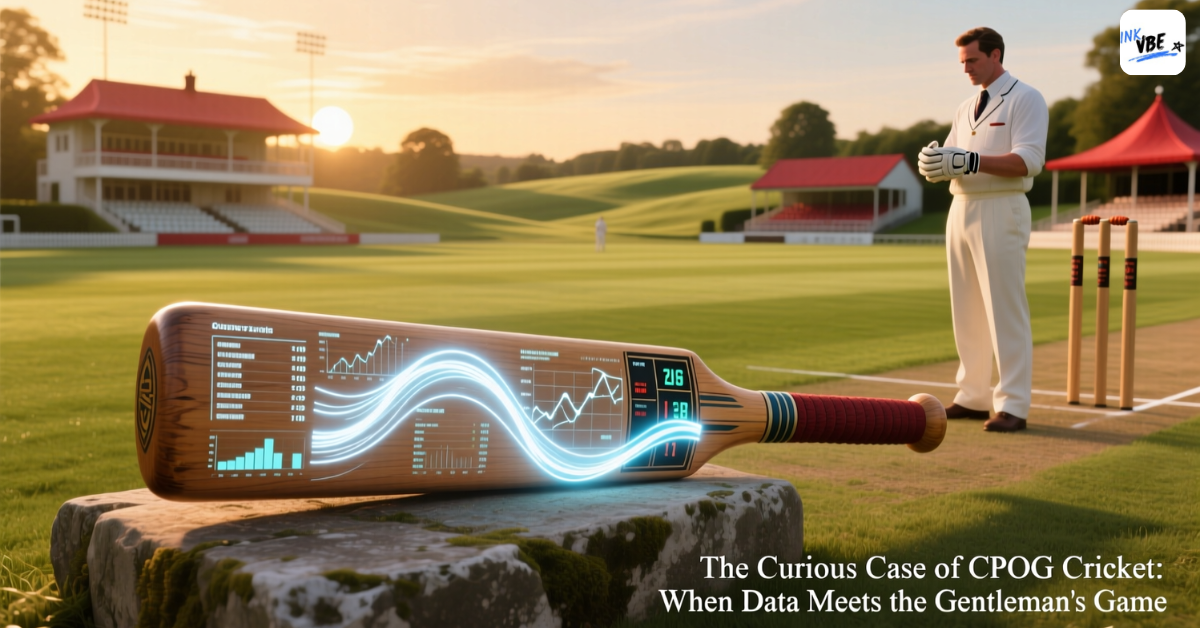

How a sport that moves at the pace of a lazy Sunday afternoon—complete with tea breaks, white flannels, and batsmen who sometimes take five minutes just to adjust their gloves—has become one of the most data-hungry arenas in modern athletics. Welcome to the world of CPOG cricket. No, it’s not a new T20 franchise or a secret society of wicketkeepers. CPOG stands for Cricket Player Output Generator, and if you’ve never heard of it, you’re not alone. But trust me, it’s quietly reshaping how the game is played, coached, and even watched—especially here in the U.S., where cricket’s slow but steady march into the mainstream just got a serious analytics upgrade.
Wait—Cricket in the U.S.? Seriously?
Hold on. Before we get into CPOG, let’s address the elephant in the room: cricket in America. Yeah, it’s real. And it’s growing. Fast.
Just look at the numbers. The International Cricket Council (ICC) now lists over 250,000 registered players in the U.S.—and that’s not counting the weekend warriors in Brooklyn basements or the pickup games in suburban Dallas parks. Major League Cricket (MLC) launched in 2023 with six teams, backed by serious investment (hello, American Cricket Enterprises and big names like Satya Nadella). Venues like Grand Prairie Stadium in Texas are filling up. And with the 2028 Los Angeles Olympics including cricket for the first time since 1900, the sport’s got a runway like never before.
But here’s the catch: American fans don’t just want to watch cricket—they want to understand it. And that’s where CPOG comes in.
So… What Exactly Is CPOG?
CPOG isn’t a single app or a flashy dashboard you can download on your phone (yet). Think of it more like a back-end engine—a statistical framework that quantifies player performance in ways traditional cricket stats never could.
Traditional cricket metrics? They’re charming but limited. Batting average? Great, but it doesn’t tell you if a player thrives under pressure or crumbles when the field’s up. Strike rate? Helpful in T20s, but meaningless in a four-day red-ball match where survival matters more than fireworks.
CPOG changes that. It blends context-aware data—pitch conditions, opposition strength, match situation, even weather—with granular tracking (thanks to Hawk-Eye, stump cams, and wearable sensors) to generate a dynamic output score for every player in every innings. It answers questions like:
- How valuable was that 35-run knock in a collapsing innings?
- Was that bowler actually unlucky, or just ineffective?
- Could this part-time off-spinner be a secret weapon in high-pressure chases?
In short, CPOG tries to measure impact, not just output.
Why Should an American Fan Care?
Fair question. If you grew up on baseball, basketball, or football, cricket’s rhythms can feel alien. Innings that last days? Overs instead of innings? A “duck” that has nothing to do with waterfowl?
But here’s the thing: CPOG makes cricket legible—especially for stats-savvy U.S. audiences raised on WAR (Wins Above Replacement) in baseball or PER (Player Efficiency Rating) in basketball. It’s the bridge between cricket’s poetic traditions and America’s love of quantifiable excellence.
Imagine watching an MLC match and seeing a real-time CPOG rating pop up next to a batter’s name—say, +2.4—meaning they’ve added 2.4 “win probability points” to their team’s chances just by being at the crease. Suddenly, that defensive block shot isn’t boring; it’s strategic. That quiet 20 off 40 balls in a chase? Maybe it’s worth more than a flashy 50 in a dead rubber.
And for fantasy cricket players (yes, that’s a thing here now)—CPOG is gold. It helps you spot undervalued players before the crowd catches on.
The Brains Behind the Numbers
CPOG didn’t spring from thin air. It’s the brainchild of a loose coalition of data scientists, former players, and cricket obsessives—many of them based right here in the U.S. One key figure is Dr. Arjun Mehta, a computational linguist by day and cricket analytics hobbyist by night, who started tinkering with player valuation models during lockdown. His early spreadsheets evolved into what’s now informally called the “Mehta Matrix,” a precursor to today’s CPOG algorithms.
What makes CPOG different from, say, ESPNcricinfo’s Smart Stats or the ICC’s own rankings? Contextual weighting. CPOG doesn’t treat all runs the same. A boundary against a world-class fast bowler on a seaming track in Manchester counts more than the same shot against a part-timer on a flat deck in Dubai. It also factors in game state: a wicket in the powerplay of a T20 carries more weight than one in the death overs if the batting team is already 10 wickets down (okay, bad example—but you get it).
Tools like Python-based PyCric, Tableau visualizations, and even custom-built TensorFlow models now feed into CPOG’s evolving architecture. And while it’s still mostly used by coaches and analysts, apps like CricClout and StumpVision are starting to surface CPOG-inspired metrics for fans.
But Isn’t Cricket Supposed to Be… Human?
Ah, the eternal tension. Purists will tell you cricket is about grace, grit, and the unquantifiable magic of a cover drive at sunset. And they’re not wrong.
But CPOG isn’t here to replace poetry with spreadsheets. It’s here to enhance the story. Think of it like sabermetrics in baseball: Billy Beane didn’t kill the romance of the game—he just helped teams see hidden value in overlooked players. Similarly, CPOG might reveal that a 22-year-old leg-spinner from New Jersey, who’s only taken two wickets this season, actually has the best “pressure dismissal rate” in the league. Suddenly, he’s not a benchwarmer—he’s a tactical ace.
And let’s be real: even the most traditional cricket nations are all in on data now. England’s “Bazball” revolution? Fueled by analytics. India’s field placements? Optimized using machine learning. Australia’s bowling rotations? Guided by fatigue models. The U.S. isn’t late to the party—we’re just bringing a different kind of punch.
CPOG in Action: A Mini Case Study
Let’s make this concrete. Picture this: Seattle Orcas vs. San Francisco Unicorns, MLC 2024. The Orcas are chasing 165 in 20 overs. At 85 for 5 in the 12th over, things look grim. Enter Rohan Patel, a local hero from Bellevue with a day job in software QA and a CPOG rating of just 0.8 coming in—barely above replacement level.
But over the next 25 balls, Patel plays the innings of his life: 42* off 23, including three sixes over long-on. The Orcas win with two balls to spare.
Traditional stats? He’s man of the match. CPOG? It shows his clutch coefficient spiked to +4.1—the highest in MLC history for a sub-50 score. Why? Because he came in during a “high-leverage” window (defined as win probability between 20% and 40%) and flipped the script. His boundary rate was solid, sure—but his dot-ball avoidance and rotation efficiency under pressure were off the charts.
That’s the kind of insight CPOG delivers. Not just what happened, but why it mattered.
The Road Ahead: CPOG and the American Cricket Dream
Here’s the exciting part: CPOG could be the secret sauce for U.S. cricket’s rise. With limited resources and a shallow talent pool compared to India or Australia, American teams need every edge. CPOG helps identify diamonds in the rough—college players, immigrant club stars, even former baseball pitchers who might have the arm action for seam bowling.
Coaches can use it to tailor training: if a batter’s CPOG tanks against spin in the middle overs, maybe it’s time for more net sessions with a mystery spinner. Scouts can compare players across formats using a unified metric. Broadcasters can explain the game in ways that resonate with data-native viewers.
And for fans? It turns passive watching into active engagement. You’re not just rooting for your team—you’re tracking win probability curves, debating leverage indexes, and arguing over whether that dropped catch cost 1.7 CPOG points. (Spoiler: it probably did.)
Final Thoughts: More Than Just Numbers
Look, CPOG won’t replace the thrill of a last-over heist or the heartbreak of a run-out by a millimeter. Cricket’s soul remains in its human drama—the dropped catches, the sledging, the spontaneous dance after a six.
But in a country where sports are increasingly viewed through a lens of efficiency, strategy, and measurable impact, CPOG gives cricket a language Americans understand. It’s not about reducing the game to algorithms. It’s about revealing layers that were always there, just hidden beneath centuries of tradition.
So next time you hear about a CPOG rating or see a win probability graph during an MLC broadcast, don’t tune out. Lean in. Because that number? It’s not cold data. It’s the heartbeat of a game learning to speak a new dialect—one that just might make cricket America’s next great sporting obsession.
And honestly? That’s worth a six over long-off any day.