
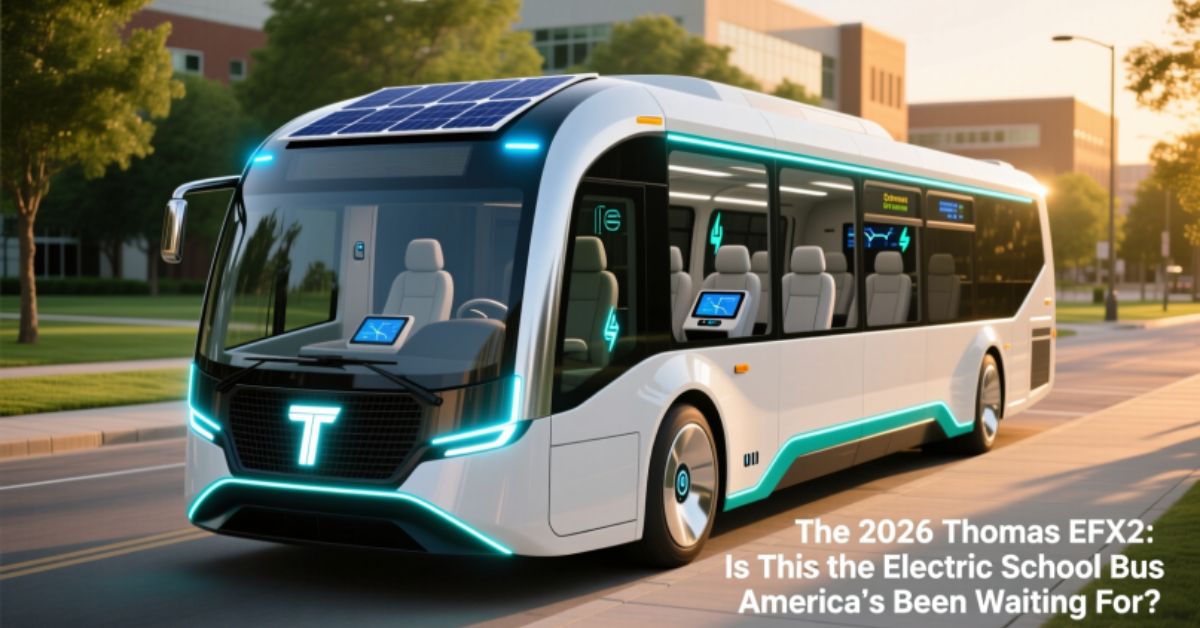

You know what’s wild? For decades, the yellow school bus has barely changed. Same boxy shape, same diesel rumble, same cloud of exhaust kids walk through every morning. But now—finally—things are shifting. And at the heart of that shift might just be the 2026 Thomas EFX2, an all-electric school bus that doesn’t just promise cleaner air, but a whole new way of thinking about how we move our kids.
Let’s be real: school transportation isn’t glamorous. It’s the quiet backbone of the American education system—reliable, unflashy, and often overlooked. Yet every weekday, nearly half a million school buses roll out across the country, ferrying some 25 million children. Most of them still run on diesel. That’s a lot of tailpipes. A lot of noise. And, frankly, a lot of missed opportunity.
Enter the EFX2.
Wait—What Even Is the Thomas EFX2?
Good question. Thomas Built Buses—yes, that Thomas, the one you probably rode in as a kid—has been around since 1916. They know school buses. And in recent years, they’ve been quietly (literally) retooling for the electric age. The EFX2 is their second-generation battery-electric model, built on the proven Saf-T-Liner EFX platform but upgraded for 2026 with better range, smarter charging, and a few surprises under the hood.
Technically speaking, it’s built on a collaborative chassis developed with Proterra, a company that’s been doing heavy lifting in the EV transit space for years (and recently got acquired by Volvo, which adds some serious engineering muscle). The result? A bus that looks familiar but behaves like something from the future.
- Range: Up to 150 miles on a single charge—enough for most rural and suburban routes, even with detours.
- Charging: Supports both depot and opportunity charging (think quick top-offs between runs).
- Battery: Liquid-cooled lithium-ion pack, designed for longevity in hot summers and icy winters.
- Noise level: So quiet, you’ll actually hear the kids chatting instead of the engine growling.
But specs only tell half the story.
Why Should You Care If You Don’t Drive a School Bus?
Fair point. Unless you’re a district transportation director or a school board member, this might feel like someone else’s problem. But here’s the thing: every child who breathes near a school bus stop is affected. Diesel exhaust isn’t just loud—it’s linked to asthma, reduced lung development, and long-term health risks, especially for kids whose lungs are still growing.
And it’s not just health. Think about the mornings: that familiar clunk-clunk-hiss as the bus door opens, the diesel fumes mixing with frosty air. Now imagine stepping outside to near-silence. No fumes. Just clean, calm air—and maybe the faint hum of an electric motor warming up.
Plus, electric buses cost less to maintain. No oil changes. No exhaust systems to replace. Fewer moving parts means fewer breakdowns. Over a 12-year lifespan, a district can save tens of thousands per bus in operational costs. Those savings could go toward hiring aides, upgrading classrooms, or fixing leaky roofs.
So yeah—it matters.
“But Aren’t EVs Too Expensive for School Districts?”
Ah, the elephant in the room. Upfront, yes—the EFX2 costs more than its diesel cousin. We’re talking $300,000 to $400,000, compared to around $120,000 for a conventional model. Ouch.
But hold on. Remember those federal and state incentives? The 2022 Inflation Reduction Act included $5 billion specifically for zero-emission school buses through the EPA’s Clean School Bus Program. And many states—California, New York, Illinois, even Texas—are stacking their own grants on top.
In some cases, districts are getting 80–100% of the cost covered. One rural district in Maine recently rolled out five EFX2s for zero dollars out of pocket. That’s not a typo.
And let’s not forget: electricity is cheaper than diesel. Way cheaper. Even with rising utility rates, fueling an electric bus costs about half as much per mile. Over time, that gap widens.
Still skeptical? Consider this: the average school bus logs about 12,000 miles a year. At today’s diesel prices (~$4/gallon), that’s roughly $12,000 annually in fuel alone. An EFX2? Maybe $5,000 in electricity. That’s $7,000 saved every year—per bus.
Now multiply that by a fleet of 50.
ALSO READ THIS POST:The Honda NX400 2026: What It’ll Cost You—and Why It Might Be Worth Every Penny
What’s New for 2026?
Thomas didn’t just slap a battery in last year’s model and call it a day. The 2026 EFX2 comes with meaningful upgrades:
- Enhanced thermal management: Better battery performance in extreme temps—critical for places like Arizona or Minnesota.
- Updated driver interface: A simplified dashboard with real-time energy use, route efficiency, and predictive maintenance alerts.
- Improved regenerative braking: Recaptures more energy on downhill or stop-and-go routes (hello, hilly towns and city traffic).
- Quieter HVAC system: Because let’s be honest—kids complain about the bus being too hot or too cold more than anything else.
There’s also a new “Community Mode”—a feature that lets the bus power external devices during emergencies. Think: using the bus as a mobile charging station during blackouts or natural disasters. It’s not just a school bus anymore; it’s a community asset.
The Human Side: Drivers, Kids, and Quiet Mornings
I talked to Maria Lopez, a school bus driver in Colorado Springs, who’s been behind the wheel for 18 years. She switched to an EFX2 pilot last fall.
“At first, I thought, ‘This is gonna feel weird.’ But honestly? It’s smoother. Quieter. Less vibration. And the kids—they notice. They ask, ‘Is this the electric one?’ They’re proud to ride it.”
That pride matters. When kids see their school investing in clean tech, it sticks with them. It’s not just transportation—it’s a lesson in responsibility, sustainability, and forward thinking.
And for drivers? Less noise means less fatigue. Less mechanical hassle means more focus on what really matters: keeping kids safe.
What About Charging Infrastructure?
Okay, let’s get practical. You can’t run electric buses without chargers. And yeah, that’s been a hurdle. But here’s the good news: most school districts already have the space and electrical capacity—they just need upgrades.
The average school bus sits idle for 18+ hours a day. That’s plenty of time for overnight Level 2 charging. For larger fleets, DC fast chargers can top up buses during midday layovers.
Companies like ChargePoint, Proterra Energy, and Blink are working directly with districts to design turnkey charging solutions. Some even offer “charging-as-a-service” models—no upfront hardware costs, just a monthly fee.
And utilities are stepping up too. In Georgia, Georgia Power offers special rates for school bus charging during off-peak hours. In California, PG&E helps districts apply for infrastructure grants.
It’s not perfect—but it’s getting easier every year.
The Bigger Picture: A Cultural Shift
Let’s zoom out for a sec. The 2026 Thomas EFX2 isn’t just a vehicle. It’s a symbol. For years, school buses were stuck in the past—literally and figuratively. Now, they’re becoming mobile classrooms for the clean energy transition.
Think about it: every time a kid steps onto an EFX2, they’re experiencing the future. No fumes. No roar. Just smooth, silent motion. That normalizes electric mobility in a way no ad campaign ever could.
And it’s happening faster than you think. As of 2024, over 15,000 electric school buses had been ordered nationwide. By 2030, experts predict that number could hit 100,000. That’s one-fifth of the entire U.S. school bus fleet.
Thomas isn’t alone—Blue Bird, Lion Electric, and IC Bus are all in the game—but the EFX2 stands out for its blend of reliability, brand trust, and real-world readiness.
So… Is It Worth the Hype?
Look, no vehicle is perfect. The EFX2 still has range limits. Cold weather can nibble at battery performance. And yes, the upfront cost stings—unless you tap into those sweet, sweet grants.
But step back and ask: What’s the cost of not switching?
More asthma cases. More carbon emissions. More money wasted on volatile fuel prices. More noise pollution in neighborhoods that already bear the brunt of industrial infrastructure.
The EFX2 won’t solve climate change by itself. But it’s a tangible, scalable step—one that puts kids first, both in safety and in future.
And honestly? It just feels right. There’s something deeply satisfying about replacing that old diesel cloud with clean, quiet motion. It’s not just progress—it’s care.
Final Thought: The Bus Stop of Tomorrow
Picture this: It’s a crisp October morning in 2026. Your kid zips up their jacket, grabs their backpack, and walks to the corner. The bus pulls up—no rumble, no fumes. Just a soft chime, a flash of headlights, and the door sliding open with a whisper.
They climb aboard, sit down, and wave.
And you think: That’s my kid. Riding into the future.
Now that’s a school bus worth talking about.