
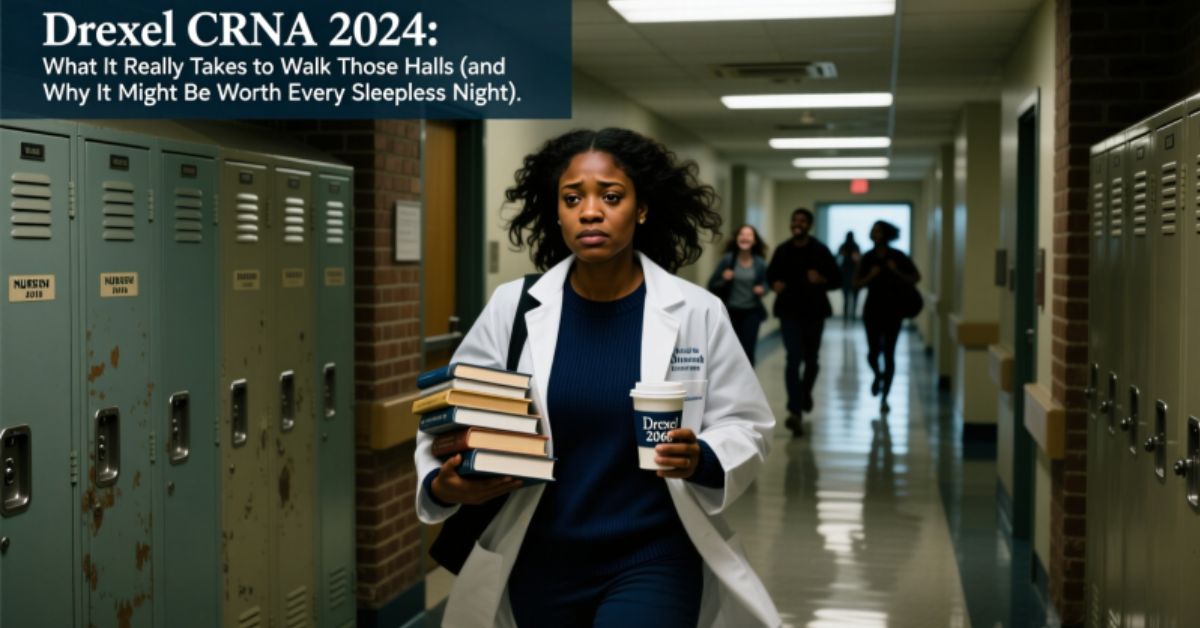

You know that feeling when you’re standing in the ICU, watching a nurse anesthetist calmly guide a patient through surgery while the rest of the room seems to hold its breath? There’s something almost cinematic about it—the quiet confidence, the precision, the way they seem to hold life in their hands without breaking a sweat. If you’ve ever thought, “I want to be that person,” then you’ve probably Googled “Drexel CRNA 2026” more than once.
And honestly? You’re not alone.
Drexel University’s Nurse Anesthesia program—especially the cohort starting in 2026—is one of the most talked-about (and competitive) paths into the CRNA world on the East Coast. But before you start mentally rearranging your life around clinical rotations and pharmacology flashcards, let’s talk about what this journey actually looks like. Spoiler: it’s equal parts exhilarating, exhausting, and deeply human.
So… What Even Is a CRNA?
Before we get into Drexel specifics, let’s level-set. CRNA stands for Certified Registered Nurse Anesthetist. These aren’t just nurses who “help with anesthesia”—they’re advanced practice providers who independently manage a patient’s entire anesthetic plan, from pre-op assessment to post-op recovery. In many rural hospitals and military settings, CRNAs are the only anesthesia providers. They’re trusted, autonomous, and highly skilled.
And yeah—they’re also among the highest-paid nursing roles in the U.S., with median salaries hovering around $200K. But let’s be real: nobody signs up for this just for the paycheck. You do it because you thrive under pressure, love physiology, and can’t stand the idea of standing on the sidelines when someone’s life hangs in the balance.
Why Drexel? (And Why 2026 Matters)
Drexel’s Nurse Anesthesia program, housed in the College of Nursing and Health Professions, has been around since the 1970s. It’s got legacy, sure—but more importantly, it’s got rigor. The program is fully accredited by the Council on Accreditation of Nurse Anesthesia Educational Programs (COA), and its graduates consistently outperform national averages on the National Certification Examination (NCE).
Now, the “2026” part? That’s not just a random year. Drexel transitioned its CRNA track to a Doctor of Nursing Practice (DNP) format several years back, in line with the national shift toward doctoral-level preparation for advanced practice nurses. The 2026 cohort will be among the first to fully experience the program’s refined curriculum—leaner, more integrated, and laser-focused on clinical decision-making.
Here’s the thing: Drexel doesn’t just teach you how to push drugs. It teaches you why you’re pushing them, how they interact with comorbidities, and what to do when Plan A collapses at 2 a.m. in the OR.
The Application Gauntlet: More Than Just GPA
Let’s not sugarcoat it—getting into Drexel’s CRNA program is like trying to thread a needle during an earthquake. For the 2026 cycle, you’ll need:
- A BSN from an accredited program (no exceptions)
- An active RN license (preferably in Pennsylvania or a compact state)
- Minimum 1 year of ICU experience (they strongly prefer 2+ years in adult critical care—think SICU, MICU, CVICU)
- A GPA of 3.0 or higher, though competitive applicants often sit north of 3.5
- GRE scores (though some cycles have waived this—check Drexel’s site religiously)
- Three letters of recommendation, ideally from CRNAs or ICU charge nurses who’ve seen you handle a crashing patient
- A personal statement that doesn’t read like a robot wrote it
But here’s what they won’t tell you on the admissions page: they’re looking for resilience. Can you stay calm when a vent alarm screams? Can you advocate for a patient when a surgeon’s rushing? Can you learn from your mistakes without crumbling?
I’ve talked to current students who said their interview wasn’t about reciting drug half-lives—it was about describing a time they failed, and what they learned. That’s the vibe.
ALSO READ THIS POST:Viral “Federal Pound Me in the Prison” GIF: A Cultural Phenomenon
Life as a Drexel CRNA Student: “Controlled Chaos” Doesn’t Even Cover It
Imagine this: it’s your second semester. You’ve just spent 12 hours in the OR at Hahnemann (yes, Drexel still uses legacy clinical sites despite the hospital’s closure—thanks to partnerships with Tower Health, Jefferson, and others). You’re running on coffee and adrenaline, your scrubs smell like antiseptic and regret, and you’ve got a pharmacology exam tomorrow on volatile anesthetics.
And yet—you’re grinning.
Why? Because today, for the first time, you managed a full anesthetic without your preceptor stepping in. You titrated propofol like a maestro, caught a subtle dip in end-tidal CO2 before it became a crisis, and even got a quiet “good job” from the attending anesthesiologist.
That’s the magic of Drexel’s clinical model. From day one, you’re not shadowing—you’re doing, under supervision, sure, but with real responsibility. By the end, you’ll have logged over 2,000 clinical hours across diverse settings: trauma, pediatrics, obstetrics, even regional anesthesia blocks that feel like performing microsurgery with nerves.
The schedule? Brutal. Classes might start at 7 a.m., clinicals run until 7 p.m., and you’ll still be reviewing cases at midnight. Weekends? What weekends? But the camaraderie is real. Your classmates become your lifeline—sharing notes, venting over Wawa hoagies, celebrating small wins like mastering the sniffing position for intubation.
The Hidden Curriculum: What Drexel Teaches Beyond the Syllabus
Sure, you’ll master the Mallampati score and know your succinylcholine from your rocuronium. But Drexel sneaks in deeper lessons:
- Advocacy: You’ll learn to speak up—not just for patients, but for the profession. CRNAs face scope-of-practice battles in some states; Drexel preps you to be part of the solution.
- Systems thinking: Anesthesia isn’t just about the patient on the table—it’s about supply chains, EHR workflows, and hospital policy. Drexel’s DNP project forces you to tackle a real-world problem, like reducing post-op nausea in ambulatory surgery.
- Emotional stamina: You’ll see patients code. You’ll comfort families. You’ll make split-second calls that stick with you. The program builds in debriefing sessions and mental health resources—because they know you can’t pour from an empty cup.
Money Talk: Yes, It’s Expensive. But Let’s Do the Math.
Tuition for Drexel’s CRNA DNP hovers around $140,000–$160,000 for the full program. Ouch. But before you panic:
- Many students secure federal graduate loans (Direct Unsubsidized and Grad PLUS)
- Drexel offers limited scholarships through the College of Nursing
- Some clinical sites offer tuition reimbursement if you commit to post-grad employment
- And remember: starting salaries for CRNAs often hit $180K–$220K, especially in high-demand areas like the Northeast or California
Is it a financial leap? Absolutely. But compared to med school (which can top $300K), it’s a more direct—and often faster—path to anesthesia autonomy.
“But What If I’m Not a Straight-A ICU Rockstar?”
Good news: Drexel isn’t looking for perfection. They’re looking for potential.
Maybe your GPA dipped during your first nursing job because you were working nights and taking care of a sick parent. Maybe you switched from med-surg to ICU later than most. That’s okay. What matters is your growth, your clinical judgment, and your “why.”
One current student told me: “I bombed my first vasoactive drip quiz. But I went back, re-did every practice problem, and asked my preceptor to walk me through real cases. They noticed the effort—and that mattered more than the grade.”
Drexel values coachable people. People who listen, adapt, and show up—even when they’re terrified.
The 2026 Edge: Timing Is Everything
Starting in 2026 puts you in a sweet spot. The healthcare system is still recovering from pandemic-era staffing shortages, and CRNAs are in high demand. Rural hospitals, outpatient surgery centers, even the VA—they’re all scrambling to fill roles.
Plus, anesthesia tech is evolving fast. Think AI-assisted monitoring, enhanced recovery after surgery (ERAS) protocols, and tele-anesthesia consults. Drexel’s curriculum is updated yearly to reflect these shifts, so you won’t graduate knowing only “how we’ve always done it.”
And let’s not forget—2026 is an election year. Healthcare policy could shift dramatically, especially around Medicare reimbursement for CRNA services. Being in school during this time means you’ll learn to navigate policy as it happens, not just from a textbook.
Final Thought: Is This Path for You?
Ask yourself:
- Can you handle being responsible for someone’s breathing—literally—for hours at a time?
- Do you geek out over acid-base balance and hemodynamics?
- Are you okay with missing birthdays, holidays, and maybe even your own dog’s birthday because you’re on call?